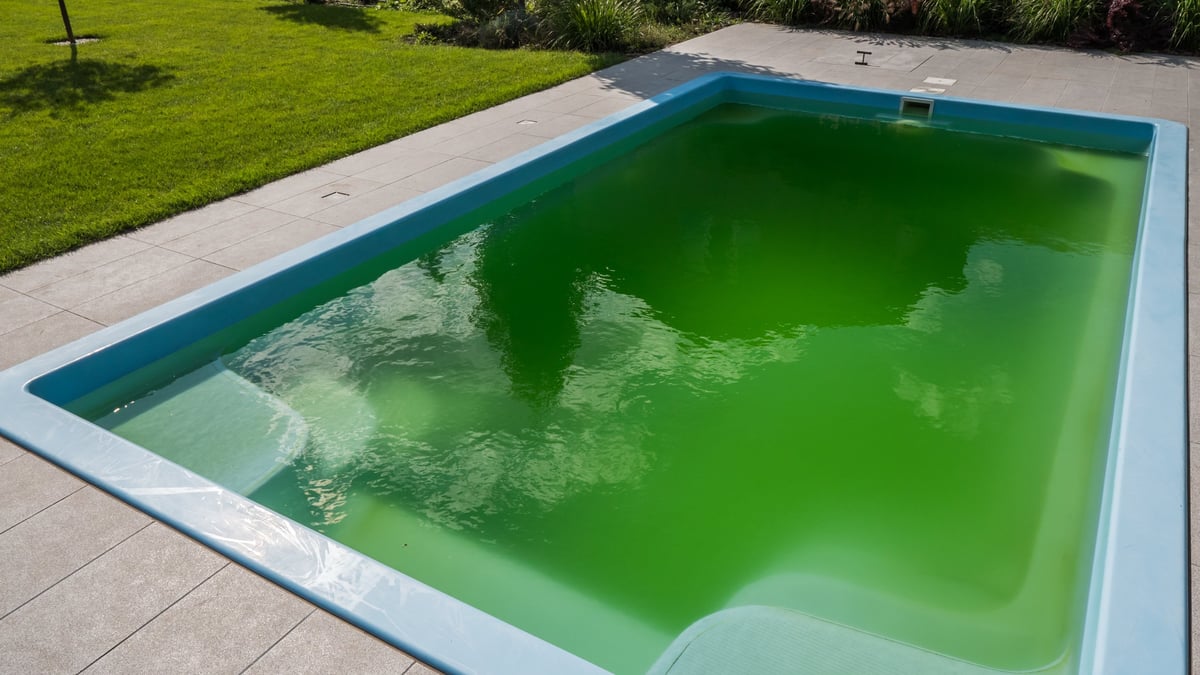
Every summer, the same phone call comes in across the East Valley: “I opened the gate and my pool is green. What happened?” It’s a smart question, and a fair one. A pool that was fine in May shouldn’t read like a swamp in July. This is the straight answer about why Arizona pools go green, what actually has to happen to get them blue again, and why it rarely gets fixed in a single visit.
1. Why does my pool turn green in the summer?
Green water is usually algae, though the color alone doesn’t prove it — metals, pollen, and cloudy water from a filtration problem can all look green-ish too. What algae need is warmth, sunlight as fuel for photosynthesis, nutrients, and water where the sanitizer has not kept up. An Arizona summer supplies the first three in abundance.
Warm water is the engine. Algae reproduce faster as water temperature rises, and an Arizona pool sitting in the high 80s or 90s for weeks is in the range where that growth is quick. Sunlight feeds the process through photosynthesis, which is why blooms often appear on the sunniest stretches rather than during a cloudy week.
What usually decides it, though, is the sanitizer. Chlorine is consumed by sunlight — ultraviolet light degrades it, which is the whole reason stabilizer (cyanuric acid) exists — and it is consumed faster when water is warm and when the pool is carrying more organic load. So summer does two things at once: it speeds up how fast algae can grow, and it shortens how long your chlorine lasts. A pool that held a healthy residual in May can be losing it faster in July with nothing else about the routine having changed.
That combination is the real story, and it rarely starts with one dramatic moment. Algae get their opening when free chlorine has been low relative to demand for a stretch — days, not hours. In practice that means a sudden green pool is usually the visible end of a slow slide the test readings were already hinting at, which is exactly why regular testing catches it and guesswork does not.
2. Is it the heat, or something I did wrong?
Usually the heat and the environment — not a personal failure. Arizona puts pressure on a pool in ways cooler states simply don’t.
Hard source water leaves calcium and scale on tile and in the strainer, and rough, scaled surfaces give algae more places to take hold. Dust that settles during a monsoon carries organic matter, and that material consumes chlorine as it breaks down — so a dusty week quietly raises demand. Intense sun degrades chlorine faster, and warm water speeds up both algae growth and chlorine loss. A pool in Queen Creek, Gilbert, Chandler, or Mesa is dealing with all of it at once in a way most of the country never does.
None of that means you failed. It means the water needs more attention through an Arizona summer than a set-and-forget routine gives it.
3. Will shocking it fix it by the weekend?
Sometimes the water clears, but shock is a treatment, not a diagnosis, and it doesn’t tell you why the pool got there. If pH, alkalinity, or stabilizer levels are off, chlorine is far less effective no matter how much you add — which is why people sometimes dose heavily and watch the pool stay green. High stabilizer (cyanuric acid) is a common culprit: it protects chlorine from sunlight, but at elevated levels it also holds back chlorine’s ability to do its job, and adding more chlorine doesn’t fix that.
There is no single shock dose that is right for every pool, and we don’t recommend treating by rule of thumb. The honest version is that recovery is chemistry correction plus mechanical cleaning plus time — and the chemistry has to be measured before you know what to correct. Our green-to-clean recovery page walks through the full sequence in order.
4. What does an honest green-to-clean recovery actually involve?
A real recovery is mostly hands-on work rather than pouring chemicals and waiting. Here’s what it typically involves:
- A real water test, not a guess. Free chlorine, combined chlorine, pH, alkalinity, calcium hardness, and cyanuric acid are all measured before anything is changed — the treatment follows the readings.
- Debris removal from the surface, the skimmer, the baskets, and wherever it has settled, so chlorine isn’t being consumed by leaves instead of algae.
- Brushing every surface — walls, steps, floor, and around the waterline. Algae attach to surfaces and form a film that shields them; brushing breaks that film so sanitizer can reach it.
- Water treatment driven by the readings, correcting pH, alkalinity, and stabilizer as needed and chlorinating to a level appropriate for the measured conditions.
- Circulation and filtration support — extended pump runtime, checking flow, and cleaning or backwashing the filter so it can actually clear the dead algae it will be collecting.
Then we verify. A pool that looks blue with the pump running but clouds up again the next morning has not finished recovering, and the follow-up readings are what tell you whether it has.
5. Why does it sometimes take more than one visit?
Because a heavy bloom is more than a surface problem. Once algae are established, the chlorine you add is being consumed on two fronts — fighting the bloom and oxidizing the organic load feeding it — so it gets used up quickly. Meanwhile the filter is clearing a volume of dead algae it was never sized for, and it can only do that so fast.
That is why recovery is often spread across several visits and extended pump runs. A pool with a mild haze and a pool that has been green for a month are very different jobs, and any honest provider will tell you which one you have before starting rather than promising a single visit.
6. How do I stop it from coming back?
Recovery only sticks when the routine that follows holds up. After the water clears, three things matter most: keeping a consistent testing and service rhythm rather than servicing it in bursts, keeping stabilizer in a sensible range so chlorine can do its job, and catching the water when it starts trending off instead of waiting for visible green.
On a full weekly service, that is what we do — test, investigate, explain, and treat what the readings call for. The “why” behind each adjustment is worth understanding, because it is what lets you spot the next slide early.
7. When is it time to call a professional?
Two signs it is worth getting eyes on it. First, if the water has gone past hazy and you cannot see the main drain, that is a bigger recovery than a weekend project. Second, if you have already treated it and the water went green again, something in the chemistry is off in a way that treating alone hasn’t addressed — and finding that requires testing rather than more of the same.
If your pool is in Mesa, Gilbert, or the East Valley and you would rather have it looked at properly, see how our green-to-clean recovery works or call us. We would rather test your water and tell you what it actually needs than sell you a treatment it doesn’t.
8. How expensive is a green-to-clean service?
Cost depends on how green, how deep, and what condition the equipment is in. A light haze is a far more contained job than a pool with a long-established bloom, and a weak filter or worn equipment can add run time and visits. That is why we don’t quote a fixed number before seeing the pool and running the test — the readings and the equipment condition are what determine the work, and we walk you through what recovery will actually involve before we start.
The bottom line
A green Arizona pool is a chemistry and filtration problem, not a mystery. Heat, sun, dust, and a sanitizer that could not keep up all push the water the same direction, and it comes back the way water always does: tested, corrected, brushed, and given time on the filter. If that looks like a job you would rather hand to someone who treats your pool as a long-term responsibility, Runestone Pool Care serves homes in Mesa, Gilbert, Chandler, and Queen Creek and handles green-to-clean recoveries by testing first and explaining what we find.