A pool is never just sitting there. Every day, it’s in a quiet fight with everything around it — the Arizona sun, dust that blows in from the desert, monsoon debris, and the simple fact that water wants to drift out of balance. Most of that fight is invisible. You can’t see it in a clear pool any more than you can see a problem building in a pool that still looks fine.
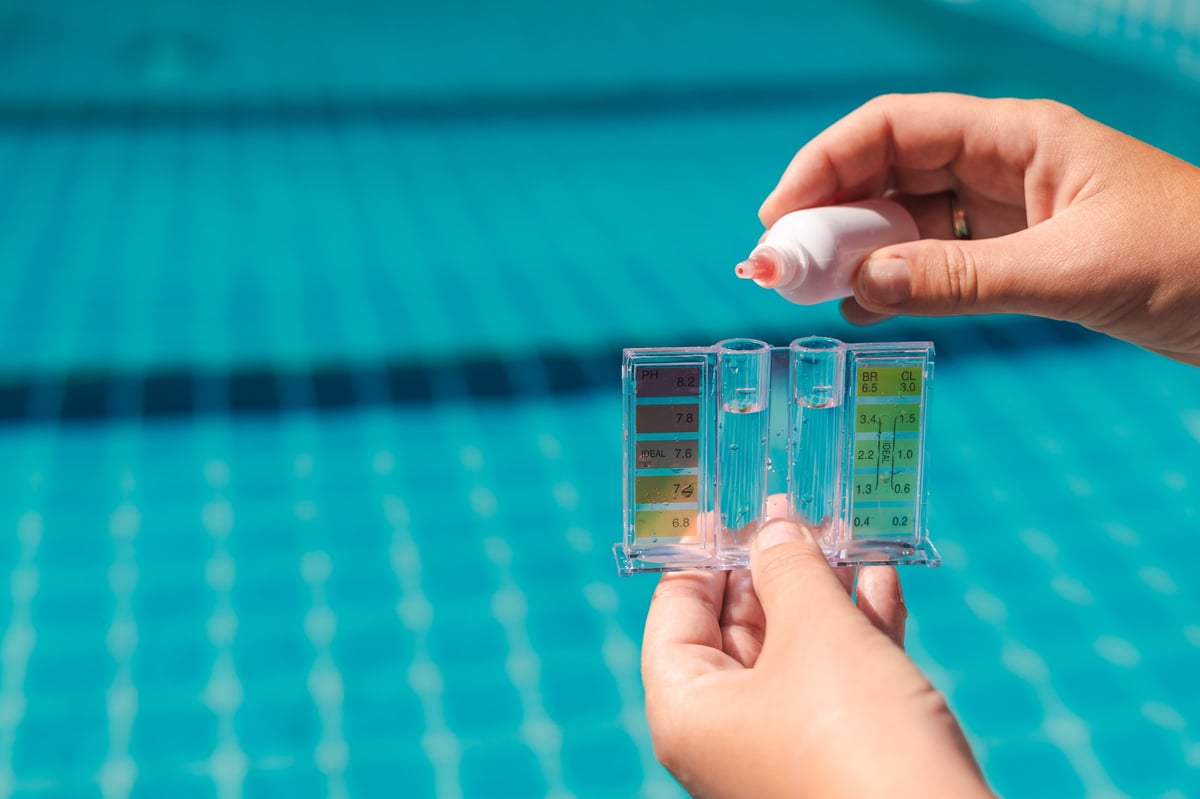
That’s why every Runestone weekly visit starts the same way: with a chemistry check. Not a glance, not a guess — a real test of three readings that tell us exactly where your water stands. Free chlorine, pH, and total alkalinity. Those three numbers are the first line of defense for your pool, and everything else we do that day is built on what they say.
Here’s what each one actually does, and why we never treat a pool without them.
Reading #1: Free Chlorine — Your Pool’s Front Line
Free chlorine is the sanitizer that’s still available to kill what gets into your water. Not the chlorine you’ve already added — the chlorine that’s still active and working right now. When algae spores, bacteria, or debris land in the pool, free chlorine is what stands between them and a green pool.
Free chlorine doesn’t hold steady on its own. The desert sun burns it off faster here than almost anywhere, which is why a pool that tests fine on Friday can slip by midweek. When free chlorine drops, contaminants get a foothold; when it climbs too high, it can irritate skin and eyes and throw the rest of the water off. The goal isn’t “more chlorine.” It’s the right amount, held consistently.
Reading #2: pH — The Balance That Decides How Well Chlorine Works
pH measures how acidic or basic your water is on a scale from 0 to 14. Most pool references point to a comfortable range around 7.4 to 7.6, close to the pH of the human eye.
pH matters because chlorine only works well in a narrow band. Push the water too acidic and chlorine becomes far more aggressive — it burns off quickly and can wear on plaster, tile, and equipment. Push it too basic and chlorine turns sluggish, sanitizing less effectively and allowing scale to form. Even a “normal” chlorine reading can be doing half its job if pH has drifted out of range.
That’s the part homeowners miss most: a green pool is often not a chlorine problem at all. It’s a pH problem wearing a chlorine costume.
Reading #3: Total Alkalinity — The Buffer That Keeps pH Steady
Total alkalinity is your water’s built-in shock absorber. It’s a measure of the dissolved minerals that resist sudden change and keep pH from bouncing around.
Think of alkalinity as the foundation and pH as the level sitting on top of it. When alkalinity is in a healthy range, pH stays put. When alkalinity is too low, pH swings wildly — up one day, down the next — and nothing you add seems to stick. When alkalinity is too high, pH climbs and locks into place, and you fight scaling and cloudiness you can’t seem to solve.
Arizona’s hard water is loaded with the minerals that push alkalinity high, so this is one of the readings we watch most closely in Mesa, Gilbert, Chandler, and Queen Creek.
Why the Three Only Work Together
These readings aren’t three separate chores — they’re one system. You can’t fix chlorine without considering pH, because pH decides how well that chlorine performs. You can’t hold stable pH without healthy alkalinity, because pH will keep drifting until the buffer is right. And you can’t hold any of it steady if free chlorine keeps getting burned off faster than it’s replaced.
That interplay is exactly why we test before we treat. Adjusting one number without reading the other two isn’t service — it’s guesswork, and guesswork is how pools drift green while the numbers on paper look “close enough.”
What Arizona Puts Your Water Through
Runestone pools live under conditions that work against water chemistry all year:
- Intense sun and triple-digit heat that burn off free chlorine fast and push pH upward.
- Hard water and heavy mineral content that drive alkalinity and calcium high.
- Dust and monsoon debris that consume sanitizer exactly when storms hit.
- Heavy use in swim season that adds to the demand on chlorine week after week.
A chemistry routine built for a mild climate doesn’t translate here. The readings that keep a pool clear in Ohio aren’t the targets that keep a pool clear in the East Valley.
What a Runestone Weekly Visit Actually Does
On every visit, we test your water and read those three numbers, then treat based on what your pool actually needs that day — not a static checklist, not a one-size-fits-all dose. We check the equipment and circulation that move and filter the water, because balanced chemistry in water that isn’t moving won’t get you a clear pool. And when something is off, we tell you what we found, what we adjusted, and why.
Testing is the first line of defense, but it only helps if someone is actually reading it, understanding it, and acting on it every week. That’s the job.
Straight Answers About Your Water
If your pool looks fine but you’re not sure what’s really going on under the surface, the answer is in the readings. Free chlorine, pH, and alkalinity tell the real story — whether your water is genuinely protected or just holding on until the next hot week.
If you’d rather not wonder whether your pool was tested, what was adjusted, or why, that’s exactly what we’re built for. Contact Runestone Pool Care to talk about a weekly chemistry check for your pool — and get clear answers about the water you swim in.