If you have ever had a pool professional hand you a test sheet with a phosphate number on it, you have probably asked the obvious question: what even is a phosphate, and why does it matter in my backyard? It is a fair question, and it deserves a straight answer instead of a sales pitch.
Here is the short version. Phosphates are compounds that enter your pool water from dust, runoff, fill water, fertilizer, and decaying organic debris. They are not a sanitizer problem on their own, but they are food for the algae that turns a clear pool green. That is why we test for them, and why a phosphate reading is one of the numbers worth understanding rather than ignoring.
Below is what phosphates actually are, where they come from in an East Valley pool, what they do and do not do to your water, and how to think about a test result without overreacting to it.
What Phosphates Actually Are
A phosphate is a compound built around phosphorus, a naturally occurring element. In pool terms, it is a nutrient. Think of it the same way you would think about fertilizer in a garden: it does not damage anything by existing, but it feeds growth.
That distinction matters. Phosphates do not eat your chlorine the way some pool-store warnings suggest. What they do is give algae a food supply, so when a small algae problem starts, it has something to grow on. Remove the food source and you make it much harder for algae to take hold in the first place.
Where Phosphates Come From in an Arizona Pool
In Mesa, Gilbert, Chandler, and Queen Creek, phosphates show up for reasons that are specific to how we live here.
- Dust and dirt. Our desert dust carries phosphorus. Every time it settles on the water and in the filter, it adds to the total.
- Monsoon runoff. Summer storms push water, soil, and debris across decks and yards and into the pool.
- Fill water. When you top off a pool, the water you add can carry its own phosphate load.
- Fertilizer and landscaping. Lawn treatments, plant food, and blown-in clippings are common sources in yards with heavy landscaping.
- Organic debris. Leaves, pollen, grass, and other material break down in the water and release phosphates as they decompose.
None of these are signs that you did something wrong. They are simply what happens to an outdoor pool in a hot, dusty climate. That is also why phosphate levels can climb even when everything else about your pool looks fine.
What Phosphates Do to Your Pool (and What They Do Not)
This is where a lot of pool advice goes sideways, so let’s be precise.
What they do: Phosphates feed algae. A pool with a steady phosphate supply is a pool where algae can bloom quickly once conditions turn in its favor, especially during long stretches of high heat.
What they do not do: Phosphates do not directly consume your chlorine, and they are not the sole cause of a green pool. Algae needs more than food. It also needs low sanitizer, poor circulation, or inadequate filtration to get a real foothold. A pool with high phosphates and properly balanced, consistently chlorinated water can stay clear all summer.
That is why we never treat a phosphate number in isolation. It is one piece of a larger picture that includes chlorine, stabilizer, calcium, alkalinity, pH, circulation, and filtration.
Why Testing for Phosphates Matters
If phosphates only matter alongside other conditions, why test at all? Because you cannot manage what you cannot see.
Testing gives you three things:
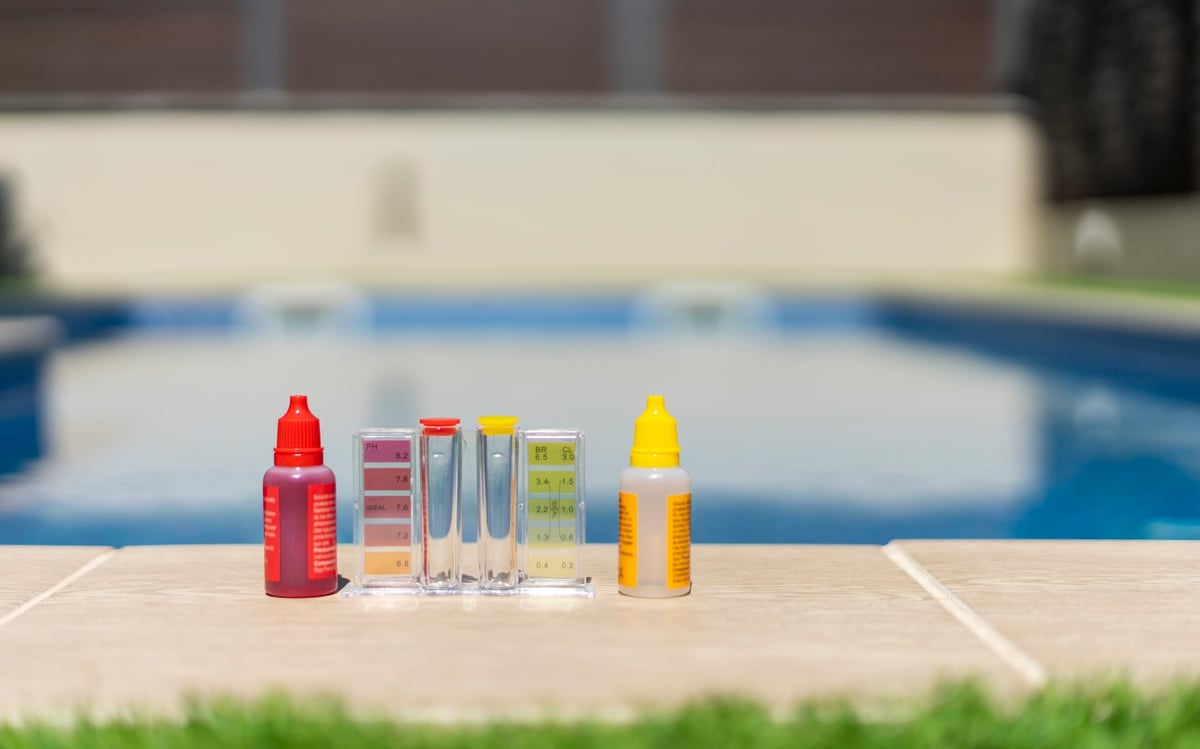
- A baseline. Without a starting number, there is no way to know whether phosphates are climbing or holding steady in your pool.
- An early warning. A rising phosphate trend tells us to look harder at circulation, filtration, and sanitizer levels before algae gets a chance to start.
- A decision point. A reading tells us whether a phosphate treatment is genuinely useful for your pool right now, or whether it would just be an unnecessary add-on.
Testing is not about finding something to sell you. It is about knowing what your water is actually doing.
How We Read a Phosphate Result
A phosphate reading only means something in context. When we test, we look at the number next to the rest of your chemistry, then ask a few practical questions:
- Is chlorine holding, or is it getting consumed faster than it should?
- Is the filter and pump moving water the way it should?
- Is there visible algae, cloudiness, or a recent bloom?
- Has anything changed recently, like new landscaping, a storm, or a top-off?
If phosphates are elevated and the pool is otherwise stable, the answer may be to watch the trend and keep the water balanced. If phosphates are high and algae is trying to gain ground, removing the food source becomes part of a larger recovery plan. The number guides the decision. It does not make it alone.
Common Myths About Phosphates
A few things worth clearing up:
- Myth: High phosphates automatically mean a green pool. They raise the risk, but algae still needs weak sanitizer, poor circulation, or poor filtration to take over.
- Myth: Phosphates eat your chlorine. They do not. Algae and other contaminants are what consume chlorine.
- Myth: Every pool needs phosphate remover on a fixed schedule. Treatment should follow a test result and a real need, not a calendar.
- Myth: A clean-looking pool cannot have phosphates. Clear water with a rising phosphate level is exactly the situation testing is meant to catch early.
What Runestone Pool Care Does With This
Every pool is different, so we do not run a static checklist and call it service. We test the water, investigate what the numbers are telling us, and explain what we find in plain language. If phosphate levels matter for your pool, we will tell you why. If they do not, we will tell you that too.
For homeowners across Mesa, Gilbert, Chandler, and Queen Creek, that means knowing exactly what was done to your pool, and why. No guesswork, no unnecessary chemicals, no mystery invoices.
The Bottom Line
Phosphates are nutrients that come from dust, runoff, fill water, fertilizer, and organic debris. They are not a crisis on their own, but they feed the algae that can turn a clear pool green. Testing for them gives you a baseline, an early warning, and a clear basis for deciding whether treatment is actually needed.
If you want to know what your pool’s phosphate level really means, have it tested and explained by someone who will tell you the truth about what your water needs. Contact Runestone Pool Care to schedule service and get straight answers about your East Valley pool.