
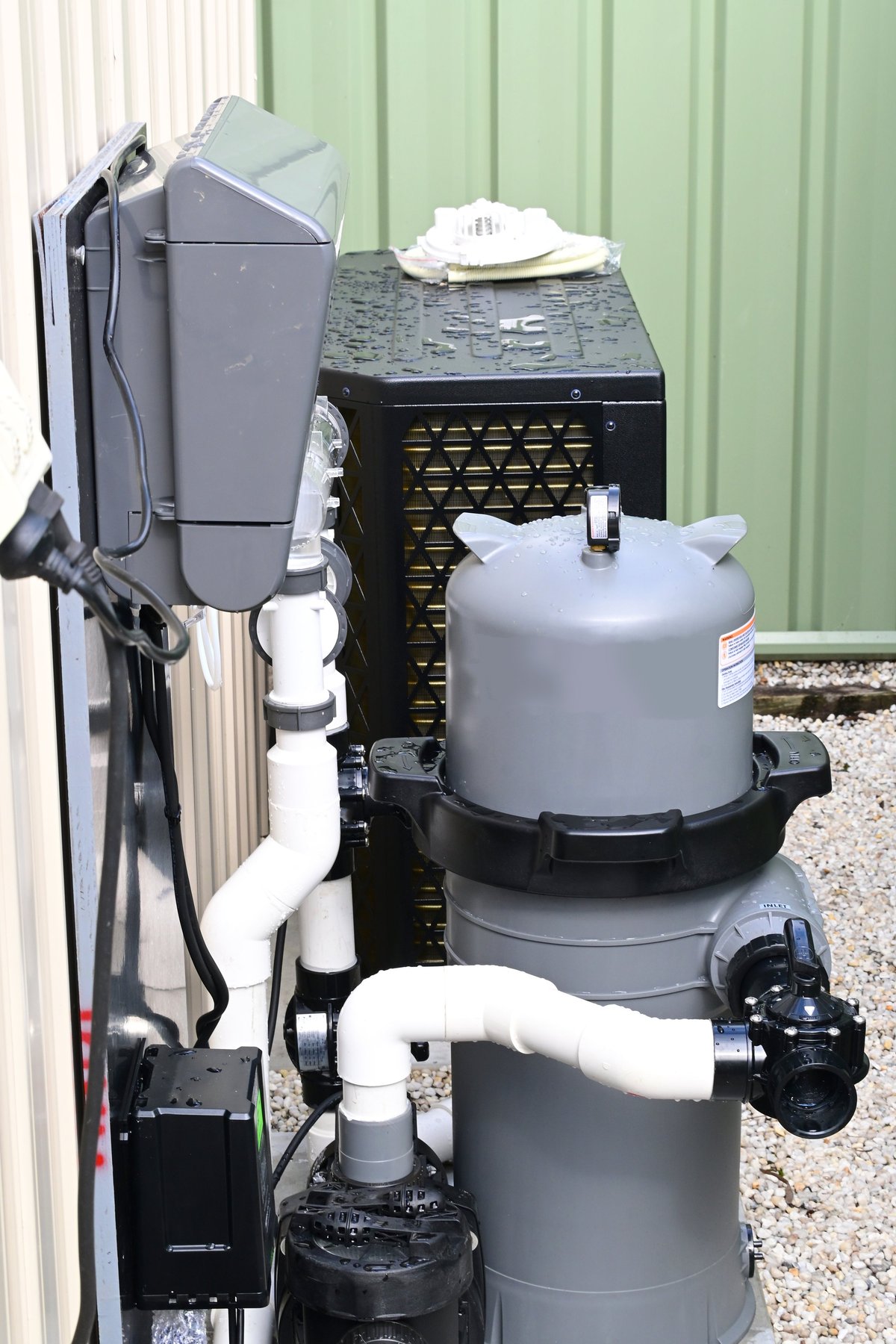
If you have ever typed “how long should I run my pool pump in Arizona?” into a search bar, you have probably gotten the same confident answer from a dozen sources: eight hours a day. Maybe six. Maybe twelve. Everybody seems sure. Nobody explains why.
Here is the honest version, and it is the version we work from every day in Mesa, Gilbert, Chandler, and Queen Creek: there is no universal number. There is only the right number for your pool, and it comes from your water volume, your actual flow, your pump speed, how your plumbing was built, what your equipment needs, and what the season is doing to your water.
Test. Investigate. Explain. That is how Runestone approaches pool care, so let us walk through what actually determines pump runtime — and, just as importantly, what does not.
Why the eight-hour rule falls apart
“Eight hours” is a shortcut, not a measurement. It assumes a specific pool size, a specific flow rate, and a specific set of equipment demands — and then it applies that assumption to every pool everywhere.
Your pool is not that pool. A 12,000-gallon play pool in Gilbert and a 30,000-gallon pool in Queen Creek do not move the same amount of water through the same system in the same amount of time. Runtime depends on six things working together:
- Pool volume – how many gallons you actually have
- Actual flow – how many gallons per minute your system is really moving right now
- Pump speed – whether you are running single-speed, two-speed, or variable-speed
- Plumbing – pipe size, run length, and fittings
- Equipment requirements – skimmer, cleaner, heater, salt system
- Season – Arizona heat, sunlight, and monsoon debris
Change any one of those and the right runtime changes with it.
The three equations that actually answer the question
You do not need a physics degree. You need three formulas, and they are the ones we use when we sit down with a homeowner.
Gallons per hour (GPH) = actual GPM (gallons per minute) × 60
Theoretical turnover hours = pool gallons ÷ GPH
GPM needed for one turnover in a chosen time = pool gallons ÷ (hours × 60)
Let us run a real example. Take a 20,000-gallon pool moving 40 gallons per minute.
- 40 GPM × 60 = 2,400 GPH
- 20,000 gallons ÷ 2,400 GPH = 8.33 hours, or about 8 hours and 20 minutes
Now drop the flow to 25 GPM, which happens more often than you would think.
- 25 GPM × 60 = 1,500 GPH
- 20,000 gallons ÷ 1,500 GPH = 13.33 hours, or about 13 hours and 20 minutes
Same pool. Same water. Nearly five extra hours of pumping — because the flow changed.
Two important caveats before you set a timer. First, those numbers illustrate what flow does to turnover time. They are not recommended daily schedules. Second, a turnover is a theoretical calculation, not a promise. Water mixes, and one turnover does not filter every single drop or guarantee your water is sanitized. Chemistry, filtration quality, and circulation patterns all matter alongside runtime.
Use your real flow — not the number on the box
The most common mistake we see is scheduling around a pump’s advertised maximum output. That number describes what the pump can do under ideal conditions. It is not what your system is doing.
Horsepower cannot tell you your GPM. RPM cannot tell you your GPM. Neither one knows what your plumbing is doing to the water.
What stands between the pump and the flow is total dynamic head — the total resistance your system puts up against moving water. Every foot of pipe, every fitting, every piece of equipment adds to it. Higher total dynamic head means lower flow from the same pump.
To know your actual operating flow, you need either a properly installed flow meter or a professional assessment. We prefer measurement. Guessing at flow is how pools end up either over-pumped and expensive or under-circulated and cloudy.
Where flow gets lost: design vs. maintenance
Plumbing design can quietly cap your flow regardless of how strong your pump is. Undersized pipes, long runs from the equipment pad, an excessive number of tight 90-degree elbows, restrictive fittings, and equipment that is mismatched to the pump all add resistance and reduce flow.
That said, do not jump to blaming the plumbing. A weak return flow has several possible causes, and most of them are maintenance:
- A dirty or clogged filter
- A clogged pump basket or skimmer basket
- Valve settings that are partially closed or pointed the wrong way
These are common, fixable, and worth ruling out first. Weak flow alone does not prove you have bad plumbing, and a professional should investigate before anyone starts quoting pipe replacement — the same order of diagnosis we describe on our equipment and repairs page.
Two more things worth saying plainly. Running your pump longer does not repair a restriction — it just pushes water against the same resistance for more hours. And a bigger pump is not automatically the answer. Without fixing what is creating the resistance, a larger pump can cost more to run without moving the water any better.
Building a variable-speed schedule
Variable-speed pumps are where the real savings live, because slower speeds move water efficiently. The catch is that you have to add up what you actually move across the day.
Gallons moved during a period = GPM × 60 × hours
If your pump runs at 30 GPM for six hours, that is 30 × 60 × 6 = 10,800 gallons. If it runs at 60 GPM for six hours, that is 21,600 gallons. To hit the same total at lower speed, you simply run longer — often at a fraction of the energy cost.
A sensible schedule does not just total up gallons, though. It has to satisfy what your equipment needs:
- Skimmer – enough flow and surface movement to pull debris in
- Cleaner – the pressure or suction your cleaner requires to actually work
- Heater – the minimum flow the heater needs to run safely and efficiently
- Salt system – the flow your chlorinator needs to produce chlorine
A schedule that hits a turnover target but starves your salt cell is not a good schedule. The right answer meets the turnover math and the equipment requirements at the same time.
What Arizona does to all of this
Everything above assumes normal conditions. In the East Valley, conditions are not normal for much of the year.
Arizona heat and intense sunlight drive chlorine demand up and algae growth on. Monsoon season drops dust and debris into the water in a hurry, and a pool that hosted a weekend of swimming has a heavier bather load to recover from. Any of those can justify more runtime — or, sometimes, simply more attention elsewhere.
That is the part homeowners most often miss: runtime is not a substitute for the rest of the work. No schedule replaces proper water chemistry, brushing the walls and steps, and keeping the filter, baskets, and surfaces clean. Pump time moves water. It does not test it, balance it, or scrub it.
The honest answer to “how long?”
Long enough to turn over your water and satisfy your equipment — based on your real volume and your real flow, adjusted for the season. For some pools that lands near eight hours. For plenty of East Valley pools it lands somewhere well above or below that, and the only way to know is to measure instead of guess.
Manufacturers publish flow and total dynamic head guidance for their pumps and filters, and that is where we start — with verified data and your actual system numbers, not with a rule of thumb passed around online.
If you would like a straight answer for your pool, request pool service and Runestone will test, investigate, and explain exactly what your pump schedule should be — and why. If your pump is part of a full weekly visit, that scheduling review is part of what weekly service covers.